
Keywords
Abstract
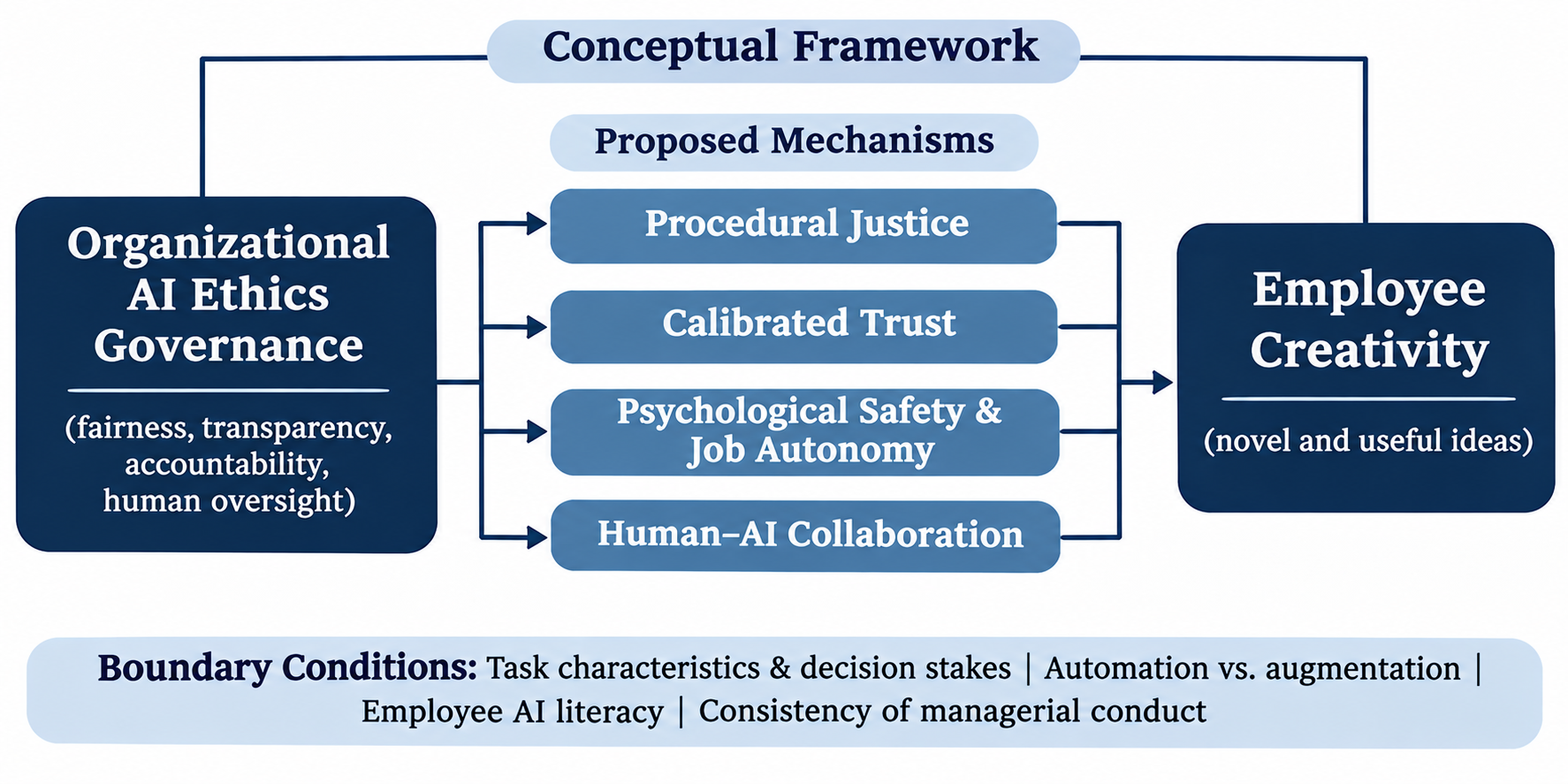
As AI becomes embedded in organizational decision-making and knowledge production, employees gain new tools for accessing and generating information while also confronting concerns about algorithmic evaluation, data use, and accountability. Drawing on research on AI ethics, algorithmic management, and organizational creativity, this conceptual study defines organizational AI ethics governance as the rules, procedures, and allocation of responsibilities that guide the development, deployment, operation, and retirement of AI systems. We argue that such governance can shape employee creativity through several connected mechanisms. Fair and contestable procedures can strengthen procedural justice, while transparent system boundaries and meaningful human review can support calibrated trust. Tolerance for responsible experimentation, together with discretion over how AI is used, can protect psychological safety and job autonomy. Governance also determines whether human–AI collaboration broadens exploration or channels employees toward standardized outputs. These effects depend on task characteristics, the stakes of AI-assisted decisions, whether AI is used primarily for automation or augmentation, employees' AI literacy, and the consistency between formal rules and managerial conduct. This study suggests that organizations should translate ethical principles into risk-based review, purpose limitation in data use, effective contestability and appeal mechanisms, employee participation, and oversight across the AI system life cycle so that AI can serve as a resource for careful creative work rather than a substitute for judgment.
References
National Governance Committee for the New Generation Artificial Intelligence. (2021, September 25). Ethical norms for the new generation artificial intelligence [In Chinese].
Anderson, N., Potočnik, K., & Zhou, J. (2014). Innovation and creativity in organizations: A state-of-the-science review, prospective commentary, and guiding framework. Journal of Management, 40(5), 1297–1333. https://doi.org/10.1177/0149206314527128
Jobin, A., Ienca, M., & Vayena, E. (2019). The global landscape of AI ethics guidelines. Nature Machine Intelligence, 1(9), 389–399. https://doi.org/10.1038/s42256-019-0088-2
Amabile, T. M., Conti, R., Coon, H., Lazenby, J., & Herron, M. (1996). Assessing the work environment for creativity. Academy of Management Journal, 39(5), 1154–1184. https://doi.org/10.2307/256995
Pei, J., Liu, S., Zhong, C., & Chen, Y. (2021). Can AI algorithmic decision-making improve employees’ perceptions of procedural justice? [In Chinese]. Foreign Economics & Management, 43(11), 41–55.
Newman, D. T., Fast, N. J., & Harmon, D. J. (2020). When eliminating bias isn’t fair: Algorithmic reductionism and procedural justice in human resource decisions. Organizational Behavior and Human Decision Processes, 160, 149–167. https://doi.org/10.1016/j.obhdp.2020.03.008
Glikson, E., & Woolley, A. W. (2020). Human trust in artificial intelligence: Review of empirical research. Academy of Management Annals, 14(2), 627–660. https://doi.org/10.5465/annals.2018.0057
Edmondson, A. (1999). Psychological safety and learning behavior in work teams. Administrative Science Quarterly, 44(2), 350–383. https://doi.org/10.2307/2666999
Parent-Rocheleau, X., & Parker, S. K. (2022). Algorithms as work designers: How algorithmic management influences the design of jobs. Human Resource Management Review, 32(3), Article 100838. https://doi.org/10.1016/j.hrmr.2021.100838
Gagné, M., & Deci, E. L. (2005). Self-determination theory and work motivation. Journal of Organizational Behavior, 26(4), 331–362. https://doi.org/10.1002/job.322
Raisch, S., & Krakowski, S. (2021). Artificial intelligence and management: The automation–augmentation paradox. Academy of Management Review, 46(1), 192–210. https://doi.org/10.5465/amr.2018.0072
Noy, S., & Zhang, W. (2023). Experimental evidence on the productivity effects of generative artificial intelligence. Science, 381(6654), 187–192. https://doi.org/10.1126/science.adh2586
Doshi, A. R., & Hauser, O. P. (2024). Generative AI enhances individual creativity but reduces the collective diversity of novel content. Science Advances, 10(28), Article eadn5290. https://doi.org/10.1126/sciadv.adn5290

This work is licensed under a Creative Commons Attribution 4.0 International License.
Copyright (c) 2026 Bing Zhang, Linpei Song