
Abstract
As a renowned tourist destination in China, Hangzhou is home to three UNESCO World Heritage Sites: the West Lake Cultural Landscape, the Grand Canal (Hangzhou Section), and the Liangzhu Archaeological Ruins. With the continuous development of international tourism, gaining a clear understanding of how foreign visitors perceive and evaluate these heritage sites has become increasingly critical for improving destination management and boosting cultural communication.
This study explores the experiences of international tourists at Hangzhou's three World Heritage Sites, drawing on English-language online reviews collected from TripAdvisor and Google Reviews. It adopts a mixed-method approach that combines Latent Dirichlet Allocation (LDA) topic modeling, an improved VADER sentiment analysis method, Importance-Performance Analysis (IPA), and manual content analysis. Based on around 1200 collected online reviews, this research identifies core themes, emotional responses, and potential service problems related to each of these heritage sites.
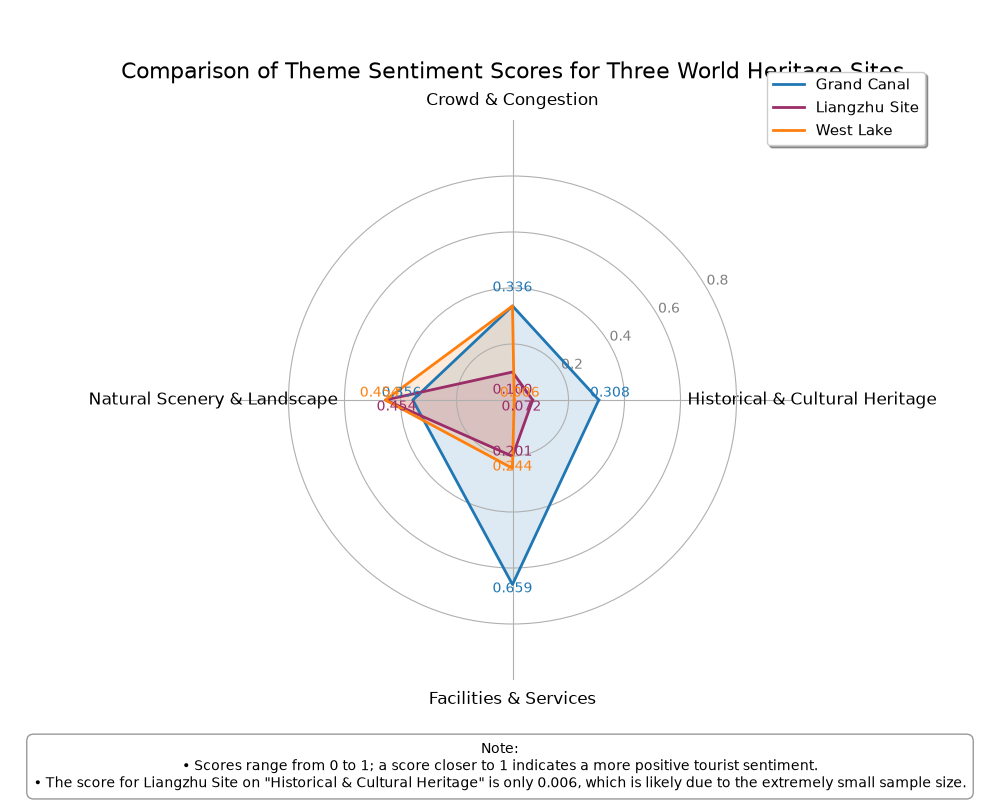
The results show that international visitors hold generally positive attitudes toward all three heritage sites, but their experiences vary in line with the distinct characteristics of each heritage type. West Lake is most commonly associated with natural scenery and cultural landscapes, yet overcrowding remains a key issue that drags down visitor satisfaction. The Grand Canal is strongly linked to historical culture and cruise experiences, though excessive commercialization may erode its cultural authenticity. Liangzhu is primarily recognized for its museum architecture and archaeological value, but insufficient multilingual support and interpretation services hinder international visitors from grasping its full cultural significance.
Overall, this study highlights how heritage type shapes international tourists' perceptions and identifies site-specific management priorities for each site. The findings indicate that effective development of heritage tourism requires not only the preservation of cultural resources, but also targeted improvements to visitor management, multilingual services, and cultural interpretation. This research also illustrates the value of text mining methods for analyzing international tourist experiences and informing management decisions at heritage destinations.
References
Blei, D. M., Ng, A., & Jordan, M. I. (2003). Latent dirichlet allocation. Journal of Machine Learning Research, 3(4-5), 993-1022.
Guo, Y., Barnes, S. J., & Jia, Q. (2017). Mining meaning from online ratings and reviews: Tourist satisfaction analysis using latent dirichlet allocation. Tourism Management, 59, 467-483.
Xiang, Z., Du, Q. Z., Ma, Y. F., & Fan, W. G. (2017). A comparative analysis of major online review platforms: Implications for social media analytics in hospitality and tourism. Tourism Management, 58, 51-65.
Xu, X., & Li, Y. (2016). The antecedents of customer satisfaction and dissatisfaction toward various types of hotels: A text mining approach. International Journal of Hospitality Management, 55, 57-69.
Kim, K., Park, O., Barr, J., & Yun, H. (2019). Tourists' shifting perceptions of UNESCO heritage sites: Lessons from Jeju Island-South Korea. Tourism Review, 74(1), 20-29.
Wang, J., Li, Y. P., Wu, B. H., & Wang, Y. (2021). Tourism destination image based on tourism user generated content on internet. Tourism Review, 76(1), 125-137.
Alaei, A. R., Becken, S., & Stantic, B. (2019). Sentiment analysis in tourism: Capitalizing on big data. Journal of Travel Research, 58(2), 175-191.
Hutto, C. J., & Gilbert, E. E. (2014). VADER: A parsimonious rule-based model for sentiment analysis of social media text. Eighth International Conference on Weblogs and Social Media.
Nie, R. X., Tian, Z. P., Wang, J. Q., & Chin, K. S. (2020). Hotel selection driven by online textual reviews: Applying a semantic partitioned sentiment dictionary and evidence theory. International Journal of Hospitality Management, 88, 102495.
Tan, S., & Wu, Q. (2011). A random walk algorithm for automatic construction of domain-oriented sentiment lexicon. Expert Systems with Applications, 38(10), 12094-12100.
Li, X., Zhang, Y., & Mei, L. (2023). Analyzing online reviews of foreign tourists to destination attractions in China: a novel text mining approach. Asia Pacific Journal of Tourism Research, 28(7), 647-666.
Martilla, J. A., & James, J. C. (1977). Importance-performance analysis. Journal of Marketing, 41(1), 77-79.
Chen, J. Y., Becken, S., & Stantic, B. (2022). Assessing destination satisfaction by social media: An innovative approach using importance-performance analysis. Annals of Tourism Research, 93, 103371.
Griffiths, T. L., & Steyvers, M. (2004). Finding scientific topics. Proceedings of the National Academy of Sciences, 101(suppl_1), 5228-5235.

This work is licensed under a Creative Commons Attribution 4.0 International License.
Copyright (c) 2026 Jiaying Fang, Qiang Zhang, Jiayu Wu