生成式人工智能职业顾问身份建构的语料库辅助话语分析——以DeepSeek与豆包对大学生就业焦虑的回应为例
DOI:
https://doi.org/10.70693/jlis.v1i1.687Keywords:
生成式人工智能, 大学生就业焦虑, 语料库辅助话语分析, 职业顾问身份Abstract
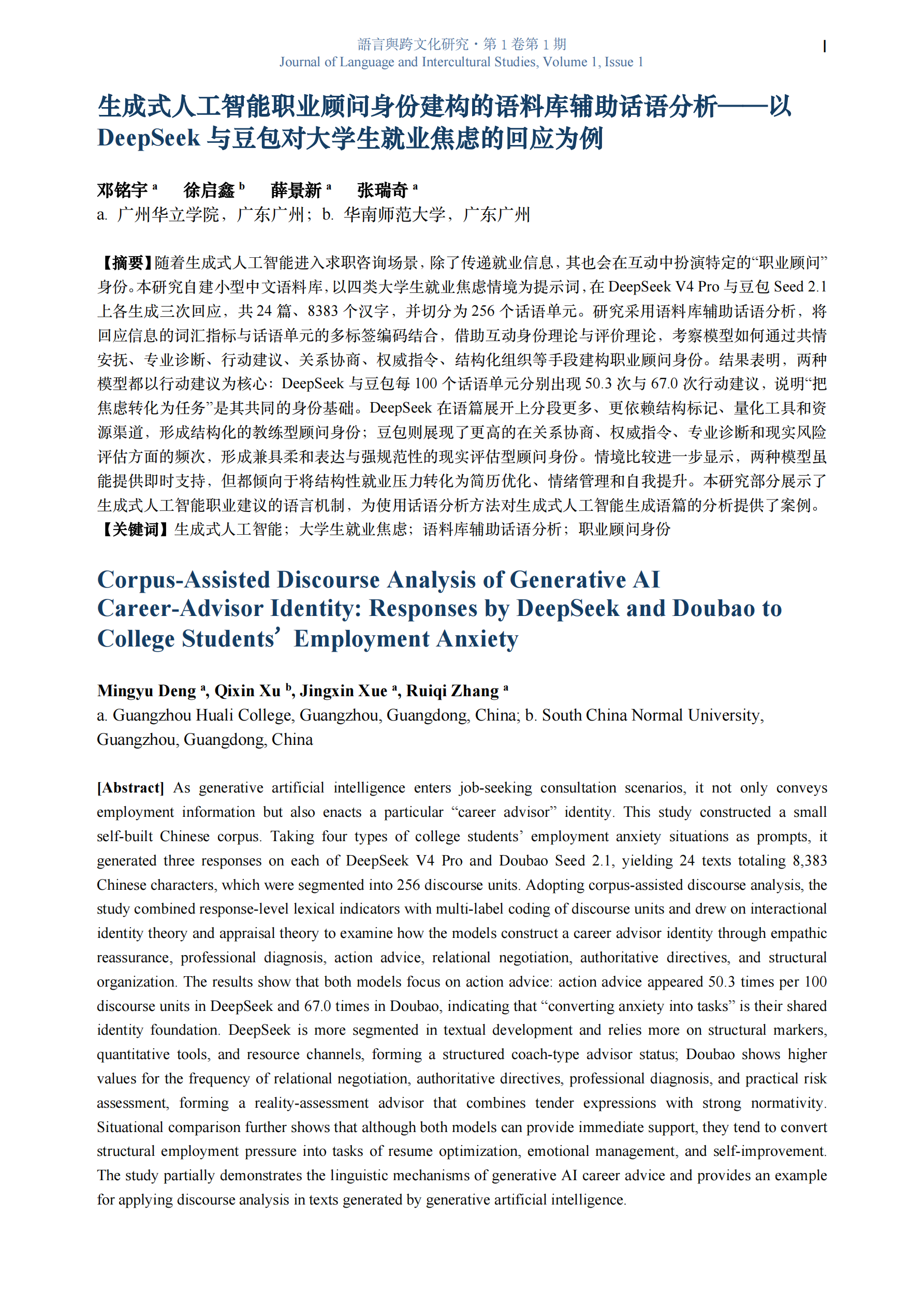
随着生成式人工智能进入求职咨询场景,除了传递就业信息,其也会在互动中扮演特定的“职业顾问”身份。本研究自建小型中文语料库,以四类大学生就业焦虑情境为提示词,在DeepSeek V4 Pro与豆包Seed 2.1上各生成三次回应,共24篇、8383个汉字,并切分为256个话语单元。研究采用语料库辅助话语分析,将回应信息的词汇指标与话语单元的多标签编码结合,借助互动身份理论与评价理论,考察模型如何通过共情安抚、专业诊断、行动建议、关系协商、权威指令、结构化组织等手段建构职业顾问身份。结果表明,两种模型都以行动建议为核心:DeepSeek与豆包每100个话语单元分别出现50.3次与67.0次行动建议,说明“把焦虑转化为任务”是其共同的身份基础。DeepSeek在语篇展开上分段更多、更依赖结构标记、量化工具和资源渠道,形成结构化的教练型顾问身份;豆包则展现了更高的在关系协商、权威指令、专业诊断和现实风险评估方面的频次,形成兼具柔和表达与强规范性的现实评估型顾问身份。情境比较进一步显示,两种模型虽能提供即时支持,但都倾向于将结构性就业压力转化为简历优化、情绪管理和自我提升。本研究部分展示了生成式人工智能职业建议的语言机制,为使用话语分析方法对生成式人工智能生成语篇的分析提供了案例。
References
Baker, P. (2023). Using corpora in discourse analysis (2nd ed.). Bloomsbury Academic. https://doi.org/10.5040/9781350083783
Baker, P., Gabrielatos, C., KhosraviNik, M., Krzyżanowski, M., McEnery, T., & Wodak, R. (2008). A useful methodological synergy? Combining critical discourse analysis and corpus linguistics to examine discourses of refugees and asylum seekers in the UK press. Discourse & Society, 19(3), 273–306. https://doi.org/10.1177/0957926508088962
Bender, E. M., Gebru, T., McMillan-Major, A., & Shmitchell, S. (2021). On the dangers of stochastic parrots: Can language models be too big? In Proceedings of the 2021 ACM Conference on Fairness, Accountability, and Transparency (pp. 610–623). Association for Computing Machinery. https://doi.org/10.1145/3442188.3445922
Bucholtz, M., & Hall, K. (2005). Identity and interaction: A sociocultural linguistic approach. Discourse Studies, 7(4–5), 585–614. https://doi.org/10.1177/1461445605054407
Du Bois, J. W. (2007). The stance triangle. In R. Englebretson (Ed.), Stancetaking in discourse: Subjectivity, evaluation, interaction (pp. 139–182). John Benjamins. https://doi.org/10.1075/pbns.164.07du
Fairclough, N. (2010). Critical discourse analysis: The critical study of language (2nd ed.). Routledge. https://doi.org/10.4324/9781315834368
Fitzpatrick, K. K., Darcy, A., & Vierhile, M. (2017). Delivering cognitive behavior therapy to young adults with symptoms of depression and anxiety using a fully automated conversational agent (Woebot): A randomized controlled trial. JMIR Mental Health, 4(2), Article e19. https://doi.org/10.2196/mental.7785
Gaffney, H., Mansell, W., & Tai, S. (2019). Conversational agents in the treatment of mental health problems: Mixed-method systematic review. JMIR Mental Health, 6(10), Article e14166. https://doi.org/10.2196/14166
Graham, S., Depp, C., Lee, E. E., Nebeker, C., Tu, X., Kim, H.-C., & Jeste, D. V. (2019). Artificial intelligence for mental health and mental illnesses: An overview. Current Psychiatry Reports, 21(11), Article 116. https://doi.org/10.1007/s11920-019-1094-0
Kanfer, R., Wanberg, C. R., & Kantrowitz, T. M. (2001). Job search and employment: A personality–motivational analysis and meta-analytic review. Journal of Applied Psychology, 86(5), 837–855. https://doi.org/10.1037/0021-9010.86.5.837
Martin, J. R., & White, P. R. R. (2005). The language of evaluation: Appraisal in English. Palgrave Macmillan. https://doi.org/10.1057/9780230511910
Partington, A., Duguid, A., & Taylor, C. (2013). Patterns and meanings in discourse: Theory and practice in corpus-assisted discourse studies (CADS). John Benjamins. https://doi.org/10.1075/scl.55
李志勇、吴明证、陶伶, & 何雪莲. (2012). 大学生自尊、无法忍受不确定性、职业决策困难与就业焦虑的关系. 中国临床心理学杂志, 20(4), 564–566. https://www.ncpssd.cn/Literature/articleinfo?id=42925094&type=journalArticle
张玉柱、陈中永. (2006). 高校毕业生择业焦虑问卷的初步编制. 中国心理卫生杂志, 20(8), 555–557. https://zxws.cbpt.cnki.net/portal/journal/portal/client/paper/edc9a29cd5c6fd29aa505704b3641c7f
Downloads
Published
How to Cite
Issue
Section
License
Copyright (c) 2026 邓铭宇, 徐启鑫, 薛景新, 张瑞奇

This work is licensed under a Creative Commons Attribution 4.0 International License.